Experiential learning (clinicals and practicum) is a vital part of the nursing program, providing students with valuable opportunities to learn alongside experienced healthcare professionals and apply their knowledge in real-world settings. Through these hands-on experiences, students develop the practical skills, confidence, and clinical judgment that are fundamental to nursing practice.
Clinical Placements
Hands-on, practical experiences in real clinical settings are a critical part of the nursing curriculum. The Clinical Placement Unit (CPU) within the School of Nursing’s Office of Academic Affairs & Student Services coordinates all student placements. This includes securing sufficient and appropriate placements for students, ensuring the appropriate affiliation agreements are in place, and that students meet the site-specific onboarding requirements.
Each agency where students are placed have been thoroughly evaluated by CPU and/or faculty to ensure the site and staff can provide an engaged, safe, and productive experience that aligns with the course learning outcomes. CPU and faculty evaluate the clinical learning environments through regular site visits.
CPU, in collaboration with faculty, are responsible for placing students into their rotations. Students do not request, rank, or preference their placements. The School utilizes a strategic process designed to provide experiential learning opportunities with broad experiences and exposures to the many aspects of the nursing profession.
Securing Placements
CPU secures clinical placements for all students. Students are not required, nor allowed to arrange their own clinical placements. Students may suggest a clinical site by emailing CPU at clinicals@nursing.wisc.edu. Students must not contact a site on behalf of the School.
All prospective sites are carefully vetted by CPU and the faculty to ensure they are appropriate for students and the course learning outcomes.
Examples
BSN programs provide a broad, generalist nursing education. Students complete clinical experiences across a variety of healthcare settings such as hospitals, clinics, schools, public health agencies, community organizations, prisons, and long-term care facilities.
DNP clinical and practicum experiences are specialized and vary by track. Students complete advanced practice experiences in settings aligned with their area of focus, such as primary care clinics, specialty practices, hospitals, behavioral health agencies, health systems, community organizations, public health agencies, and leadership settings.
Clinical Requirements
This is an accordion element with a series of buttons that open and close related content panels.
Clinical Completion Requirements
Experiential learning courses must be completed during the term of enrollment. Term dates can be found on the university’s Academic Calendar. Clinical work and clinical hours must be completed within the term dates. Some clinical courses are broken down into shorter session within a term.
Clinical work cannot be started prior to the first day or after the last day of the term. Exceptions may be considered in the case of extenuating circumstances or if a student is assigned an Incomplete grade for the course. Exceptions should be requested via the Petition for Special Consideration.
Required Tracking Systems
There are two third-party, web-based systems the School of Nursing partners with to track clinical experiences. Students are required to set up an account with each system. There is a one-time fee for each.
Exxat is the clinical and practicum tracking system used to track placements, clinical hours, patient logs, activity logs, evaluations, and student profile.
Viewpoint Screening is the tracking system used to manage compliance documents required by the School of Nursing.
In addition, each clinical site has onboarding requirements which may include their own unique tracking system. Students are responsible for any costs associated with onboarding at clinical sites.
Uniform
BSN Uniform Requirements
TBSN and ABSN students are required to purchase the approved uniform: a gray scrub top embroidered with the SoN logo and gray scrub pants (jogger scrubs are allowed). Uniform tops must be purchased from the UW Book Store, online or in person at the Health Sciences Learning Center, 750 Highland Avenue. Uniform pants are available for purchase at the UW Book Store or may be purchased elsewhere.
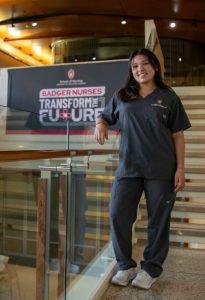
BSN Dress Code by Location
CTEN Lab (Skills Lab, Open Lab, Drop-in Lab): Plain or ‘Badger’ long or short sleeved t-shirt with scrub pants and footwear that covers your entire foot.
CTEN Simulation: Must wear approved uniform and white, closed toe and closed heel shoes. Students may wear a solid-white, solid-gray, or solid-black short or long sleeved shirt under their uniform top.
Clinical Site: Must wear approved uniform, white closed toe and closed heel shoes, and ‘BSN Student’ identification badge. Students may wear a solid-white, solid-gray, or solid-black short or long sleeved shirt under their uniform top. Some sites may have an different dress code that students should follow.
Professional Appearance
Guidelines: Students should follow professional appearance guidelines when in clinical settings. Additional requirements may be set by a particular clinical agency.
Hair: Loose strands should not brush or fall into work area or fall in front of your face when leaning forward.
Fingernails: Should be a length that does not interfere with work and can easily be kept clean and neat. Nail polish should be a conservative color and free from chips.
Jewelry: Earrings should be small and designed so they will not scratch the patient or catch on anything. Rings should be limited to one or two significant rings, such as a wedding or friendship ring, that will not scratch the patient and can be kept clean. Bracelets and necklaces should be avoided.
Items to avoid: Avoid wearing jeans, shorts, t-shirts, sweatshirts, sweatpants, sandals, clothes with graphics/art/messages. Clothes that are too tight, too short, dirty, or wrinkled should not be worn.
Perfume: Perfume should not be worn in clinical as it may be offensive or harmful to patients.
Personal Hygiene: Students are expected to practice good personal hygiene etiquette.
Transportation
Transportation to Clinical Sites
The School of Nursing places its students in a variety of venues in and beyond Madison. Students are responsible for arranging their own transportation to and from their clinical sites. Sites may be located up to 90 miles from Madison for undergraduate students and 100 miles for graduate students. Therefore, students are required to have access to reliable transportation. Students are responsible for all transportation costs incurred, including gas and parking fees. As an alternative to owning a car, students can carpool, rent a car, use a taxi or ride share (i.e., Lyft), or rent a Zipcar.
BSN students complete an annual transportation survey to indicate special transportation needs. Placement locations are not guaranteed based off information submitted in the survey, but responses are taken into consideration.
Students with extenuating circumstances that impact their clinical transportation options (e.g., driving/medical restrictions) should review the Special Considerations within Clinical Placements section.
Driving During Clinical Shifts
Students who are expected to drive as part of their clinical hours must complete UW-Madison’s Authorized Driver process. An example is having a placement in home health where students drive between patient homes. If applicable, students will receive information when onboarding for the clinical placement.
Outside Employment
Employment obligations cannot take precedence over academic, laboratory, or clinical requirements. Students are expected to adjust work schedules to meet all program requirements.
Special Considerations
Students completing experiential learning may request special consideration via the Petition for Special Consideration. Examples of circumstances that may warrant consideration include a major illness, medical leave, or military leave. For transportation considerations, review the Transportation section.
Students with disabilities who require accommodations should work with the McBurney Disability Resource Center to determine appropriate accommodations.
Submission of the petition does not guarantee your request will be approved and may require additional communication and/or meetings depending on the situation.
Functional Abilities Standards (BSN)
Students are responsible for providing safe, effective care in both classroom and clinical learning environments. Students must be able to perform certain essential functions related to communication, observation, critical thinking, professional behavior, and physical participation in patient care activities.
The Essential Functional Abilities Standards help ensure:
- Students can participate fully in classroom, simulation, laboratory, and clinical learning experiences.
- Students, faculty, peers, and patients remain safe in educational and healthcare settings.
- Students are able to meet the clinical requirements of the BSN curriculum.
- The School can fulfill requirements established by healthcare organizations.
If a student is unable to fulfill the essential functional abilities, they must work with their provider to complete and submit the Medical Release to Return to Clinical/Lab/Simulation.
Contacts

Ann Johnson
Position title: Clinical Placement Coordinator
Email:
amjohnson46
Phone: 608-263-5329

Rikki Klassy
Position title: Clinical Placement Coordinator
Email:
klassy2
Phone: 608-263-5167